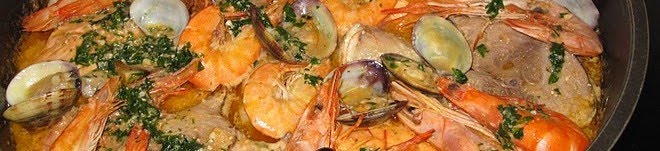
How can I make a "fideuà" that is more or less the same... as my mother cooked?
Here's what I did:
I went to Chinatown to buy the fish. I found out on the Internet that the Fish shop in the Upper West had closed, so I surfed the net and it said that the best option was to go to Chinatown. One more thing my mum taught me it was to distinguish fresh fish by just looking at it, so I went around the shops and looked for fresh shrimp which I found. They looked wonderful! Have a look

I bought them with their head and skin on which I needed to make the fish stock or broth. I also bought a piece of fish which looked similar to “congrio”, (the translation the dictionary gives is: “conger”.) I asked the man what it was but I could not understand what he said with his very heavy Chinese accent. When I touched it I realized it was not the “conger” I know, the skin was not smooth but it made, together with the heads and the skin of the shrimp, one onion and one carrot, a delicious stock!


I also bought some calamari, which is not the same as cuttlefish (not to say the taste and texture) but they belong to the same family!

and finally some scallops, which we do not have in Spain in big quantities. In Galicia you may buy them with their shells, delicious indeed, but they are very expensive!! I thought scallops would give a stronger fish taste to the “fideuà” and they truly did! I bought some big and some small:

How did I proceed?
Prepare the stock as shown above. Add salt to taste.
At some point during the process, I prepared an “Allioli” in a mortar or pestle, the Catalan way, with garlic and oil. Smash the garlic, add a pinch of salt and add olive oil very slowly while constantly mixing in the same direction until you obtain a thick paste. You just need to be patient and do it slowly. If you want faster results you can add an egg yoke. And if you want an even faster result you can smash the garlic cloves (2 or three) and mix them with mayonnaise. It won’t be exactly the same but we have been quite “unfaithful” to Spanish cooking rules all the time!
Then, I cleaned the shrimp. I removed the head and the skin and added them (skin and heads) to the stock.
I cleaned the calamari: I removed the bone and everything they had inside, the eyes, the mouth and sliced them in rings.
I washed the scallops and drained them.
The next step is to take care of the pan and how you add the contents:
1.Put some olive oil on the pan and heat it. Add 7 or 8 entire cloves of garlic when the oil is hot, and brown them slowly and evenly, helping yourself with a wooden spoon or spatula. When they are really dark, remove them from the pan and discard.
2.With the same oil, slightly fry the shrimp without the skin for 2 minutes, and put them aside.

3.With the same oil fry the calamari for a few minutes, until they are tender, and put them aside together with the shrimp.


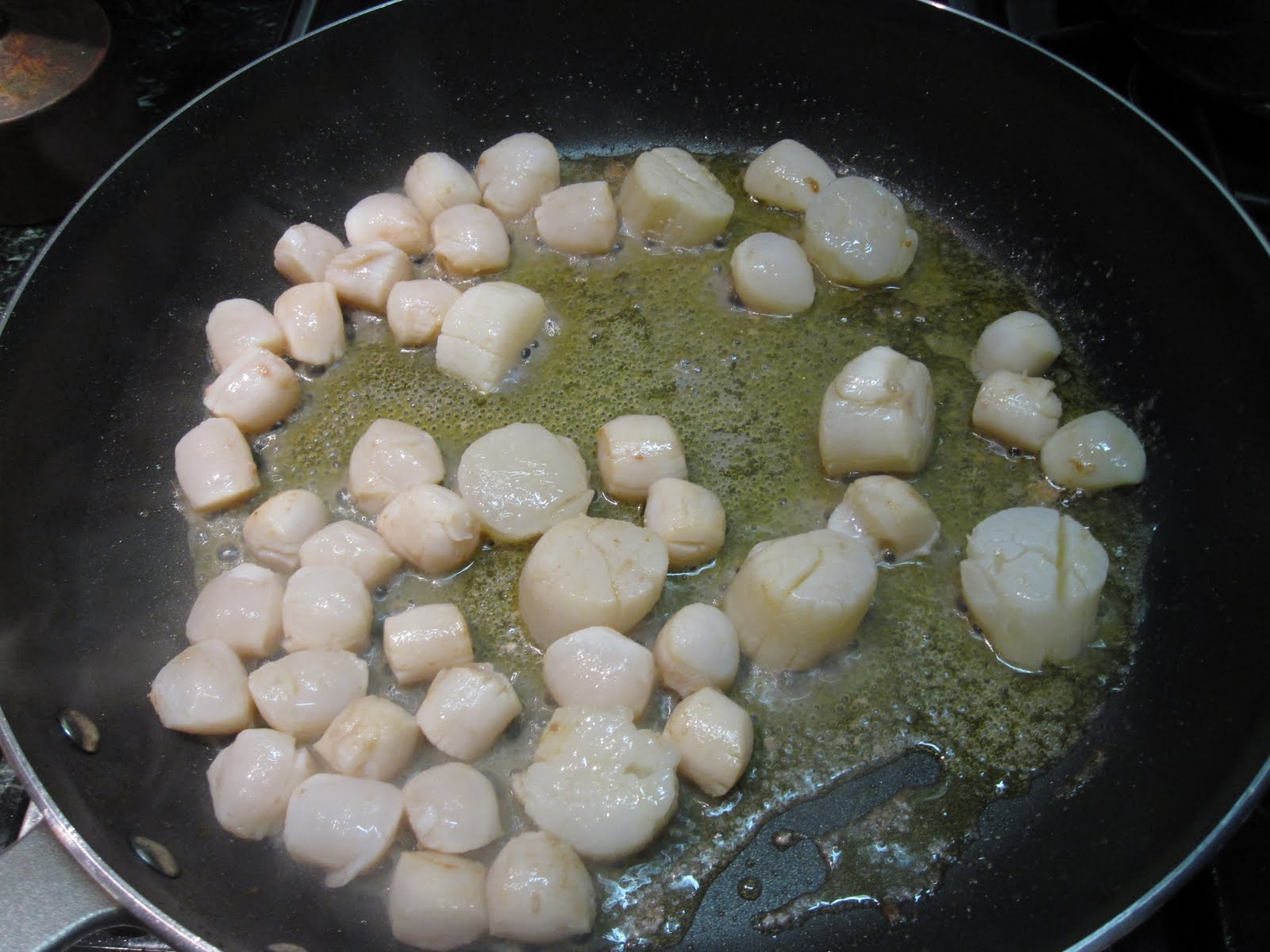
4.Still, with the same pan and oil, fry the scallops until they are a bit brown on both sides. With a spoon take the water that the scallops have released and add it to the stock. Put the dried scallops aside.
5.Add some olive oil to the same pan. Heat it and add the noodles. I could not find the noodles I use in Spain but I used Kosher egg noodles instead. Move and mix the noodles constantly with two spatulas until they become light brown:

6.When the noodles are brown add enough stock to cover them but not more. Use a drainer to catch the fish parts, so you only get broth. Add all the fish and let the stock dry. It will only take a few minutes to cook. When the broth is absorbed put the pan into the oven with the broil on for two more minutes. The noodles should rise!
Then the “fideuà” is ready!

Serve it with a spoonfull "alioli" on the side.
Here are my two observers, Leta and Danny…

And here we are ready to eat with Marcela, Dani, me (the Unfaithful Cook) and Leta.

Mmmmm it was delicious!
Don’t forget to serve a nice Spanish cold white wine with the dish and add a fruit salad as a desert. You need something really refreshing after the meal!!

Enjoy
The Unfaithful Cook
PS: If you dare... leave your comments!


